A few weeks ago I met a lovely client, Sarah. Like many women in her late 40s, she was doing a bit of juggling. Her role was demanding, she was caring for her ageing parents, and recently, she had started having some challenges in her relationship.
From the outside, she looked like she was coping pretty well. She was capable and getting everything done, but she admitted to me that she had started to feel quite flat. Because she had been so focused on everyone else’s needs, she had stopped noticing her own.
Before we spoke about making changes, the first step was understanding her energy.
This is about more than just focusing on whether you’re getting a good night’s sleep, eating well or having an extra coffee. It means becoming curious about the different ways we experience energy and using those insights wisely.
Sarah found her workplace demanding but energising, whereas the repetitive and negative conversations with her elderly parents were draining. She spoke about feeling powerless because she couldn’t resolve their challenges, and recognised that her low mood created distance with her partner.
Energy isn’t simply something we have or don’t have – and it’s something that can shift in an instant.
It’s impacted by a whole range of factors including the activities we pursue and the people and environments we spend time in. While it is affected by how well we sleep, what we eat and whether we’re exercising, it’s also influenced by our emotions and levels of stress.
There isn’t one neat formula to find the right kind of energy. What we need in one moment can be different from what we need in the next. And the goal isn’t to feel energised all the time.
It’s about becoming more aware of the different states we move through and thinking about what they might be telling us. Sometimes we need rest. Sometimes we need to be challenged. Sometimes we need a little more nourishment, connection, space or stillness.
Where is your current energy?
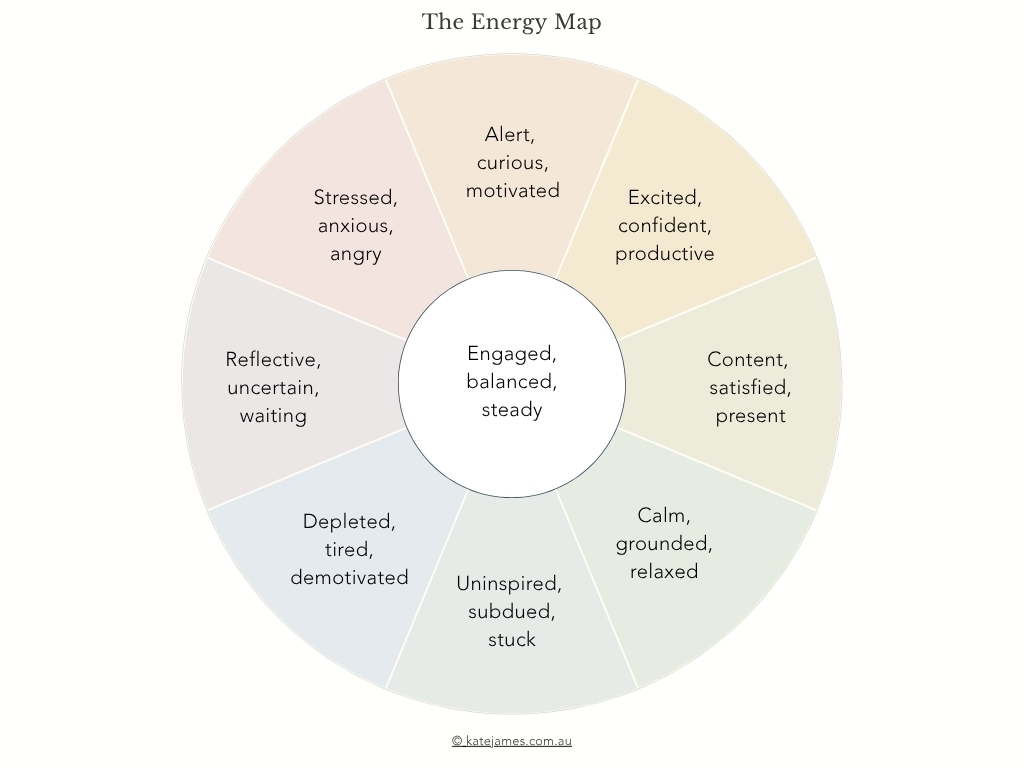
Take a look at the energy map above and consider where you are at the moment.
You’ll notice that the areas at the top are where we feel most energised, those in the middle are more neutral, and the areas at the bottom occur when our energy states are lower.
It’s also worth noting that high energy doesn’t always feel pleasant and low energy doesn’t always feel worse. There are both pleasant and unpleasant states in the high-energy areas, and the same for the lower-energy ones. We can feel calm and grounded as a low energy state, yet we know these feelings restore us. Likewise, we might feel more energised when we’re anxious, restless, or frustrated.
Our energy states are rarely static, and many experiences shift them. Across the course of a week (or even a day), you may find that you move around large parts of the circle.
When Sarah looked at the map, she noticed something interesting. Although she often accomplished a great deal while caring for her ageing parents, she found even a few hours left her depleted. By contrast, a long day at work with intellectually stimulating colleagues often left her feeling energised.
Most of us know that a single conversation, a brisk walk on a winter morning or listening to an uplifting piece of music can shift the way we feel.
The more we notice these shifts, the more we begin to understand the relationship between what we are doing, who we are with and our energy levels.
We can also tune into what researchers call an optimal form of energy.
In his 1990 book Flow: The Psychology of Optimal Experience, Hungarian-American psychologist Mihaly Csikszentmihalyi explored the conditions that allow us to experience the state of deep engagement he called ‘flow’. Csikszentmihalyi found that flow tends to occur when we are doing something that is challenging enough to hold our attention, but not so difficult that we feel overwhelmed. We find it when we are using our natural abilities and fully focused on the task in front of us. During such times, we experience a sense of contentment and feelings of satisfaction that come from the activity itself.
This state of deep engagement represents a particularly meaningful and nourishing form of energy.
Interestingly, Csikszentmihalyi suggests that flow isn’t primarily a state of happiness, but one of complete absorption.
An invitation to notice
As you look at the energy map, start to tune into your own energy states and consider the factors that are currently influencing you. This will include people, places and activities, as well as your own emotional states.
What leaves you feeling drained, depleted or tired?
Try to think beyond physical tiredness or how much you have on your to-do list, and consider the circumstances where your energy is drained more quickly.
Not all exchanges of time, effort and energy are equal.
A one-hour meeting with arguing colleagues might feel entirely different from a couple of hours of problem-solving with others who inspire you. A short social event with certain family members might be more draining than a long catch-up with your closest friends. A few hours looking at spreadsheets could be more taxing than a full day of physical work in the garden.
We can also be physically tired but emotionally energised.
You may also find that activities that usually provide a boost of pleasure, such as socialising or watching your favourite television program, leave you feeling drained when you overindulge.
The key is to start really noticing.
What makes you stressed or anxious?
Next, notice what leaves you feeling stressed, anxious, irritable or even angry. It’s helpful to pay attention to how these feelings are experienced in your body. Anxiety and anger, while not feeling particularly pleasant, can be more energising emotions, while depletion usually feels heavier.
What are the elements contributing to these feelings? While it’s possible that some factors are external, others may arise from the expectations you place on yourself.
Maybe you’ve been overly people-pleasing, not setting boundaries or putting yourself under unnecessary pressure.
You might also notice that your regular habit of reading the news, scrolling through social media or watching a violent television series exacerbates these feelings.
What makes you feel alive?
There is no universally right way to boost your energy – the key is to tune into your own insights.
Certain environments may feel energising or uplifting. Being in nature or around colour, listening to music or engaging in any form of creativity might bring you back to vibrancy.
Being around positive people, spending time with your pets, and moving your body can also help enormously.
The elements can be surprisingly simple and just noticing them can be revealing.
What helps you to feel more relaxed?
While a glass of wine at the end of the day might offer immediate relaxation, finding your way back to a true feeling of calm might involve something deeper.
For some it’s a daily practice of meditation, journalling, a regular yoga class or the support of a compassionate therapist. For others, it’s a regular evening without television or devices, a soak in the bath, watching the ocean or allowing yourself to properly rest.
Again, the key is in noticing.
The energy of engagement
As you become more aware of how your energy fluctuates, see if you can also notice any moments of deep engagement, such as those described by Csikszentmihalyi.
You may find that flow occurs in various different places. Perhaps it occurs while you’re mentoring someone at work, tending your garden, writing, painting, cooking, solving a complex problem or having a meaningful conversation. You might experience it while making something with your hands, caring for someone you love or learning a new skill.
The common thread is that you are completely absorbed in whatever you’re doing.
A few questions to reflect on
Look beyond your to-do list and consider what kind of energy you need at the moment.
- What kind of energy am I in need of right now?
- What makes me feel calm and relaxed?
- What makes me feel engaged and alive?
- When do I feel most balanced and steady?
- When do I lose track of time?
- What activities leave me feeling most like myself?
- What people and environments bring out the best in me?
- Am I making time for these things, as well as the things on my task list?
For a week or two, tune into your energy before, during and after different parts of your day. When do you feel more engaged? More grounded? More connected?
Perhaps you’ll realise you’ve been missing something small, such as time for a creative activity, an opportunity to cook something new or a conversation with a friend who always leaves you feeling lighter. Or perhaps you’ll notice that something you once believed was restorative now leaves you a little more tired.
You may discover that you don’t need to overhaul your life to feel differently. Often it’s the smallest adjustments that create the biggest shifts: a small amount of time in nature, saying no to one extra commitment, making space for a hobby you’ve neglected or just allowing yourself to rest.
When we begin paying attention to our energy with curiosity rather than judgement, we get to know ourselves more deeply. And often that’s where real change begins.
If you notice that you’re feeling a little depleted and need some time and space to pause and reset, my November retreat might be just what you need. It’s a small, intimate retreat for thoughtful women who want to reconnect with themselves.